GET INSPIRED


By adopting eco-friendly and digital solutions across production, operations, administration, marketing, and sales, businesses can reduce their environmental impact while enhancing and market appeal. Embrace these efficiency strategies to position your company at the forefront of the green economy. Embrace these strategies to position your company at the forefront of the green economy.

OUTBOUND LOGISTICS

Activities involved in converting the inputs into finished products and services. This includes manufacturing, assembling, packaging and testing.

READ MORE

CUSTOMER SERVICE

Supporting and enhancing the product or service after sale, including customer support, warranties, repairs and maintenance.

READ MORE

OPERATIONS

The process of transforming inputs into finished goods or services, including tasks like manufacturing, assembling, packaging and testing.

READ MORE

MARKETING & SALES

Promoting and selling products or services through activities like advertising, sales efforts, pricing and managing distribution channels.

READ MORE

INBOUND LOGISTICS

 Receiving, storing, and managing materials or inputs that are essential for the production process.

READ MORE

INFRASTRUCTURE

Company-wide systems and structures that support the entire value chain, such as finance, accounting, legal and organizational structure.

READ MORE

HUMAN RESOURCE MANAGEMENT

Recruiting, training and managing the company's workforce.

READ MORE

TECHNOLOGY DEVELOPMENT

Engaging in research, innovation and technological advancements to improve products or services.

READ MORE

PROCUREMENT

Sourcing and purchasing materials or inputs required for production.

READ MORE

Circular Economy

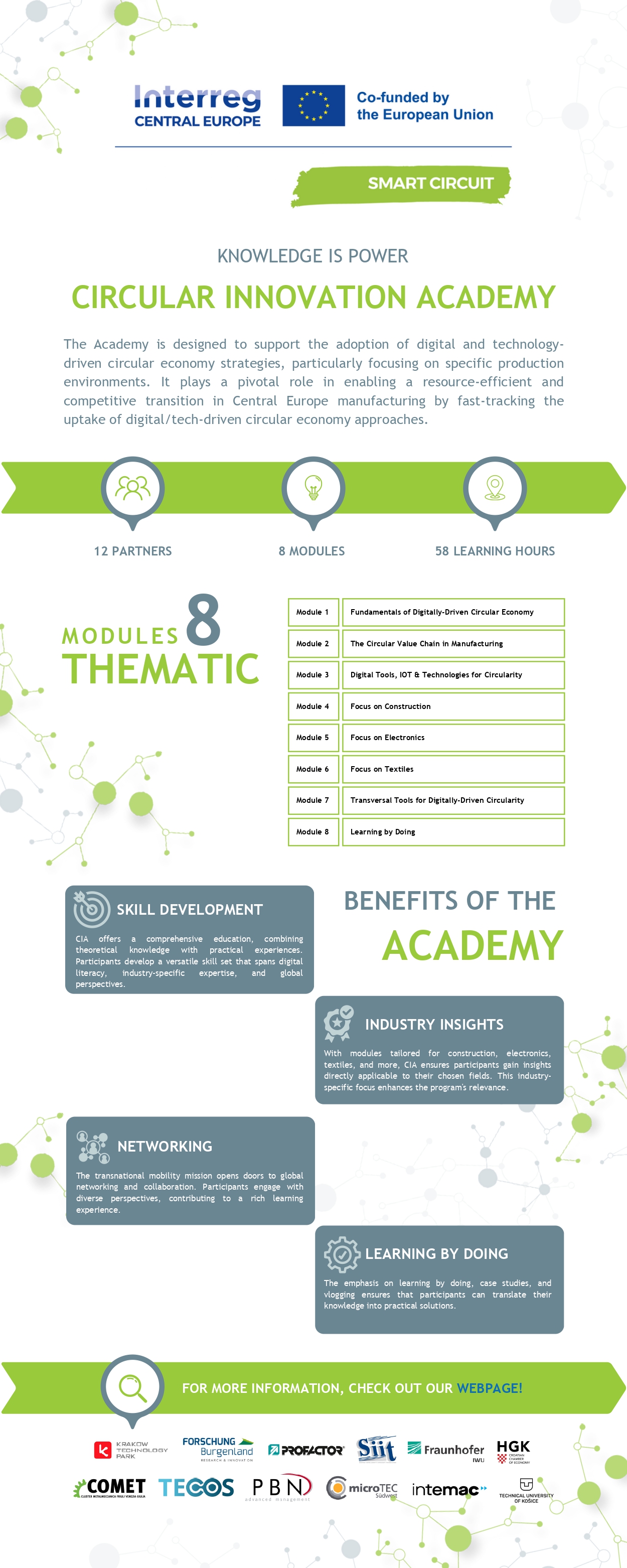
Circular Innovation Academy

Purpose: The Circular Innovation Academy (CIA) is an advanced training program designed to equip participants: Digital Innovation Hubs (DIHs) specialists, entrepreneurs, business practitioners, innovators and policy makers with the necessary knowledge and skills to provide practical tools and frameworks to design, implement, and scale circular economy solutions in order to navigate the digitally driven circular economy. By integrating digital technologies such as IoT, AI, blockchain, and data analytics into circular business models, CIA empowers learners to transition from traditional linear systems to sustainable, resource-efficient practices.

Short description: CIA offers a structured learning experience through eight specialized modules, each focusing on a key aspect of circularity in various industrial sectors. Participants will explore topics such as digitally-driven circular economy fundamentals, circular value chains in manufacturing, the role of digital tools and IoT, circular construction, electronics, textiles, and transversal tools for circularity. The program provides a mix of theoretical knowledge, real-world case studies, and hands-on applications, ensuring that learners can implement circular economy principles effectively within their industries. Whether you are a business leader, sustainability professional, or digital innovation enthusiast, the CIA program offers a comprehensive roadmap to mastering the future of circularity in the digital age. 

Themes:
Module 1: Fundamentals of Digitally-Driven Circular Economy – Learn the core principles and drivers of a circular economy enhanced by digitalization.
Module 2: The Circular Value Chain in Manufacturing – Understand how circularity can be integrated into product life cycles and manufacturing processes.
Module 3: Digital Tools, IoT & Technologies for Circularity – Dive into smart technologies like IoT, AI, digital twins, and extended reality to power circular innovation.
Module 4: Circularity in the Construction Sector – Explore sustainable construction practices and digital tools enabling circular buildings.
Module 5: Electronics and E-Waste Management – Focus on circular electronics design, repairability, and recovery of critical materials.
Module 6: Circular Approaches in Textiles – Discover sustainable textile production and reuse, with emphasis on circular design thinking.
Module 7: Transversal Tools for Circularity – Learn about cross-cutting digital skills like life cycle analysis, data sharing, and green KPIs.
Module 8: Learning by Doing – Apply what you’ve learned through real case studies and practical scenarios for hands-on experience.

Duration: 58 Learning Hours

Sector: Electronics, Construction, Textile, Cross Sectoral

How to Access:
You can access the platform and all course content for free via Moodle. Register here: REGISTRATION
To receive the enrolment password, please contact us at the following email address: thomas.kremsner@hochschule-burgenland.at

Need help? Download the user guide: USER GUIDE

Developed under project: Smart Circuit