GET INSPIRED


By adopting eco-friendly and digital solutions across production, operations, administration, marketing, and sales, businesses can reduce their environmental impact while enhancing and market appeal. Embrace these efficiency strategies to position your company at the forefront of the green economy. Embrace these strategies to position your company at the forefront of the green economy.

OUTBOUND LOGISTICS

Activities involved in converting the inputs into finished products and services. This includes manufacturing, assembling, packaging and testing.

READ MORE

CUSTOMER SERVICE

Supporting and enhancing the product or service after sale, including customer support, warranties, repairs and maintenance.

READ MORE

OPERATIONS

The process of transforming inputs into finished goods or services, including tasks like manufacturing, assembling, packaging and testing.

READ MORE

MARKETING & SALES

Promoting and selling products or services through activities like advertising, sales efforts, pricing and managing distribution channels.

READ MORE

INBOUND LOGISTICS

 Receiving, storing, and managing materials or inputs that are essential for the production process.

READ MORE

INFRASTRUCTURE

Company-wide systems and structures that support the entire value chain, such as finance, accounting, legal and organizational structure.

READ MORE

HUMAN RESOURCE MANAGEMENT

Recruiting, training and managing the company's workforce.

READ MORE

TECHNOLOGY DEVELOPMENT

Engaging in research, innovation and technological advancements to improve products or services.

READ MORE

PROCUREMENT

Sourcing and purchasing materials or inputs required for production.

READ MORE

B2GreenHub supports

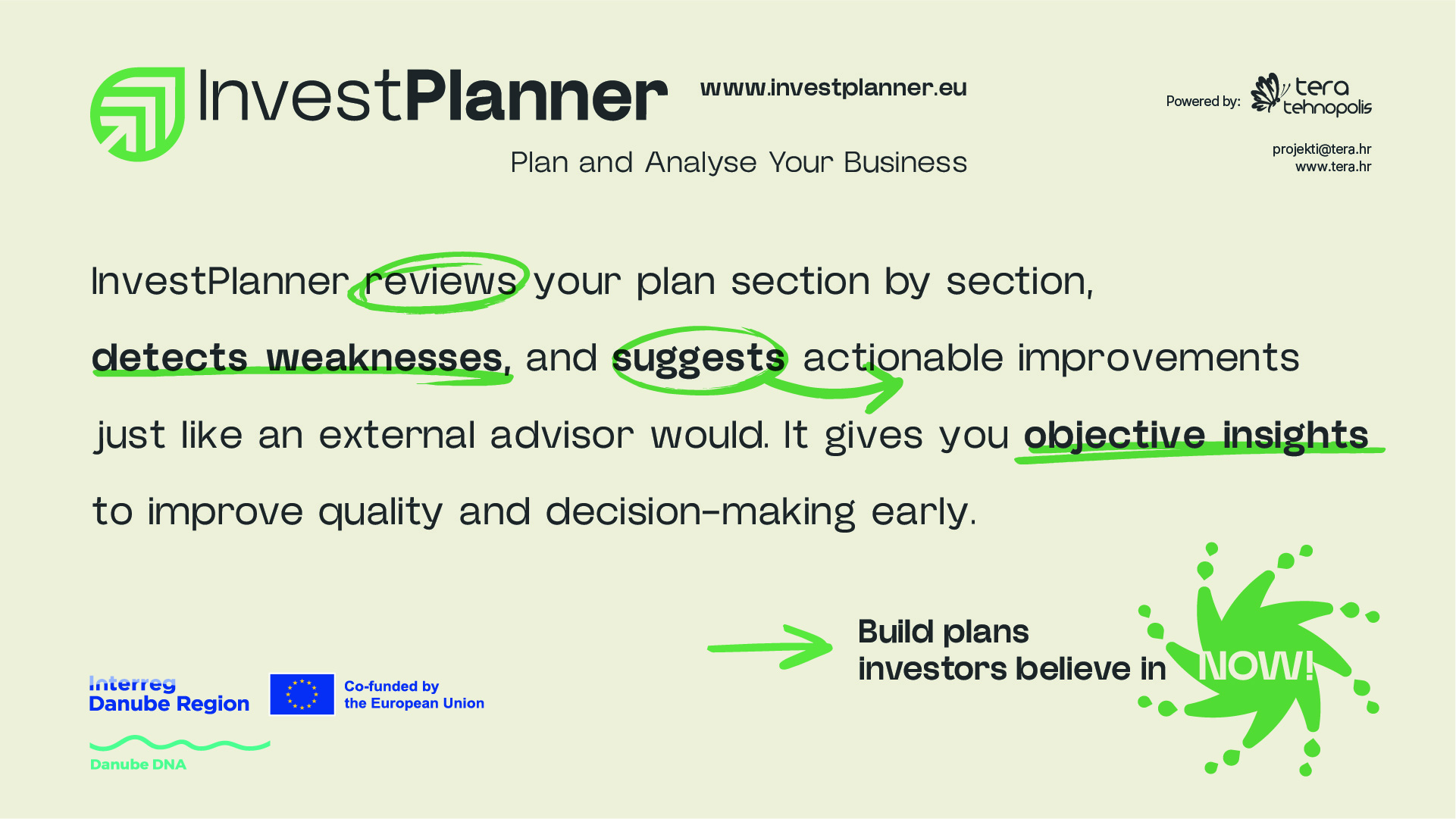
supports SMEs in turning business ideas into stronger plans, improved KPIs and professional reports

InvestPlanner

Project:

Solution Seeker:

Beta Consulting

Beta Consulting provides business and investment consulting services, supporting clients in preparing feasibility studies, investment documentation, financial projections and business planning materials.

Size:

Micro company (< 10 employees and/or turnover or balance sheet total ≤ EUR 2 million)

Sector:

Other

Country:

Serbia

Region:

Vojvodina

Partner Organization:

TERA Tehnopolis

TERA Tehnopolis is a regional centre for technology transfer supporting innovation, offers services in business planning, internationalisation, digitalisation, and IP management. It has supported over 160 startups and 250 SMEs and leads initiatives like the “Be the Role Model™” exhibition.

Sector:

Circular Economy

Country:

Croatia

Region:

Osijek-Baranja

Challenge

Beta Consulting prepares investment and business documentation for clients who need to present complex projects in a clear and financially justified way. In hospitality projects, this includes many connected elements: investor profile, location, investment value, own contribution, loan financing, lease conditions, expected revenues, operating costs, profitability and payback period. The challenge was to test whether InvestPlanner could help structure these inputs into a coherent investment study and make the link between descriptive project information and financial feasibility indicators clearer

Solution & Result

Beta Consulting tested InvestPlanner on a restaurant investment case for Luca Restoran / The Village national restaurant. The tool was used to organise project information, including the investor, location in Luštica Bay, investment structure, own contribution, credit financing, lease assumptions, expected revenues and financial feasibility indicators.
B2GreenHub supported the process by enabling access to the piloted solution and knowledge transfer on how AI-supported planning tools can assist consultants in preparing business and investment documentation. InvestPlanner helped Beta Consulting create a more structured draft of the investment study and connect narrative project sections with financial planning elements.
The pilot case included a planned investment, credit financing, own contribution, projected financial effects, NPV, IRR and payback period. The main result was a clearer structure for hospitality investment documentation and a practical method for reviewing whether project assumptions are complete, consistent and ready for expert consulting validation.

Learning tips & recommendations

For consulting companies working on investment studies, it is important to collect all key project inputs before using a digital planning tool: investment value, financing sources, loan conditions, expected revenues, operating costs, lease terms, location advantages and employment effects. InvestPlanner can support the preparation of a first structured draft and help identify missing or inconsistent information, but the final document should always be reviewed by a consultant. The best approach is to test the tool on one real client case and then adapt the workflow for similar future projects.