Project:

Partners involved:


Elettrocablaggi S.r.l.
Elettrocablaggi srl is an Italian SME manufacturing electrical wiring and cabling systems. Operating in a high-mix environment, the company aims to improve internal logistics efficiency through flexible automation of warehouse handling tasks.
Size:
Mid-sized company (< 250 employees and/or turnover ≤ EUR 50 million or balance sheet total ≤ EUR 43 million)
Sector:
Machinery & Equipment
Country:

Italy
Region:
Lombardy

Exsensia
Exsensia srl is an Italian technology company developing intuitive robotic automation software. Its platform enables fast deployment of flexible solutions for material handling, logistics, and warehouse automation in SME manufacturing environments.
Sector:
Automation and Robotics
Country:

Italy
Region:
Lombardy

Elettrocablaggi srl manages a high-mix production environment where frequent material movements between the automatic vertical warehouse and the production area are required. These loading and unloading activities were mainly manual, creating inefficiencies, dependency on operator availability, and limited scalability during peak workloads. Manual handling also introduced variability in execution, increasing the risk of delays, errors, and non-value-added time. The company needed a flexible automation approach capable of integrating with the existing warehouse system without major layout changes, while ensuring reliable operation and easy reconfiguration for SME production needs.
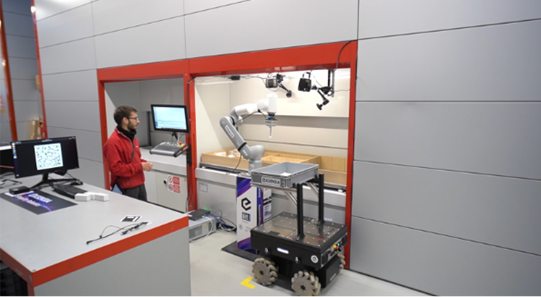
The challenge was addressed through the deployment of a flexible robotic solution integrating a fixed robotic arm positioned near the automatic vertical warehouse and a mobile robot used to transport materials between the warehouse interface and the transfer area. The full workflow (loading, unloading, transport, synchronization, and safe states) was programmed using the Exsensia intuitive automation platform, enabling rapid configuration and easy reconfiguration without low-level coding.
The pilot was implemented following the GREENE 4.0 Pilot and Testing Methodology (D3.4.1) and supported by the B2GreenHub client journey, which facilitated matchmaking between solution seeker and provider, structured pilot execution, and validation in a real SME environment. The solution was tested in realistic conditions through functional, integration, and repeatability tests.
Results include improved process repeatability, reduced manual handling, and increased operational efficiency of warehouse-related logistics. Key performance indicators monitored during the pilot included: cycle time per warehouse operation, number of manual handling steps, operator involvement, and task repeatability. Quantitative improvements (before/after) can be reported based on site measurements (e.g., cycle time reduction, decrease of manual interventions, number of successful automated cycles).
Start with a clear mapping of the warehouse workflow and identify the most repetitive handling steps to automate first. Design the solution around a stable handover area and ensure accurate positioning between mobile robot and fixed arm. Use modular task programming and parametric positions to simplify future reconfiguration. Validate early with short functional tests, then move to repeatability tests under realistic operating conditions. Involve operators from the beginning to improve usability and acceptance. Finally, define a small set of KPIs (cycle time, manual interventions, success rate) and monitor them during the pilot to quantify benefits and guide scaling to additional stations or tasks.